
Decision paralysis is not a data problem nor a knowledge problem; it's a fear problem. What keeps us frozen is the fear of regret. To escape decision paralysis, we need to treat past decisions like a great boss would: with patience, fairness, and belief in your growth.
In this post we share the mental model, dubbed the three-self framework: your past, present, and future selves, and show why being kind to your past self is what frees you to act.
The Boss We All Wish We Had
Don't we all wish we had a boss like this: someone who is supportive, and always has your back. Someone who gives you time and space to get things done, instead of hovering and micro-managing. Someone who is forgiving when you make an honest mistake. Someone who genuinely believes you have the potential to grow.
First, the bad news. In the real world, a boss like this is very hard to find. If you've found one, congratulations (and send them my resume)!
But here is the incredible good news: you can be that boss - to yourself.
So what does being your own boss have to do with decision paralysis? Everything. Whether you act or freeze comes down to one question: how safe does it feel to be wrong? And nothing sets that feeling more than the boss. Including the one in your head.
Let's dive in.
The Flavors of Decision Paralysis
Decision paralysis comes in different flavors and names:
- Analysis paralysis: more research feels safer than committing.
- Optimization paralysis: a good option is never good enough, because a better one might exist.
- Choice overload: too many options to compare.
Whatever the flavor, the cost is the same. Not just the unmade decision - also the hours spent circling it, and the frustration with yourself (or with the universe, for being so confusing).
The Real Root: Fear of Regret
A common belief: better decisions come from more data. Do more research, and the right choice will reveal itself.
It sounds reasonable. But it doesn't hold up.
There is no perfect decision. Situations change. Most outcomes have factors outside your control. A great decision can still produce a lousy result. And you will always know more later - so hindsight can always find something to blame. More data cannot change any of that.
Lack of "decision energy" isn't the culprit either. You may have heard of decision fatigue: too many choices drain your mental battery. The evidence is surprisingly weak - a large-scale study of millions of medical decisions found no general fatigue effect.
What actually keeps us frozen is the fear of regret. What if I choose wrong? What if future-me looks back and judges?
Fear of regret is a straitjacket. As long as you haven't chosen, you can't have chosen wrong. So you don't choose.
This fear shows up in various forms: the fear of not being good enough is the same freeze in different clothes. As long as you haven't started, you can't have fallen short.
Here's the irony. What limits us is almost never a wrong move. It's not making enough moves. Indecision leads to inaction. Inaction leads to no results. No results feed more self-doubt. The spiral tightens.
So where does the fear of regret come from? From how you treat your own past decisions.
The Three Selves
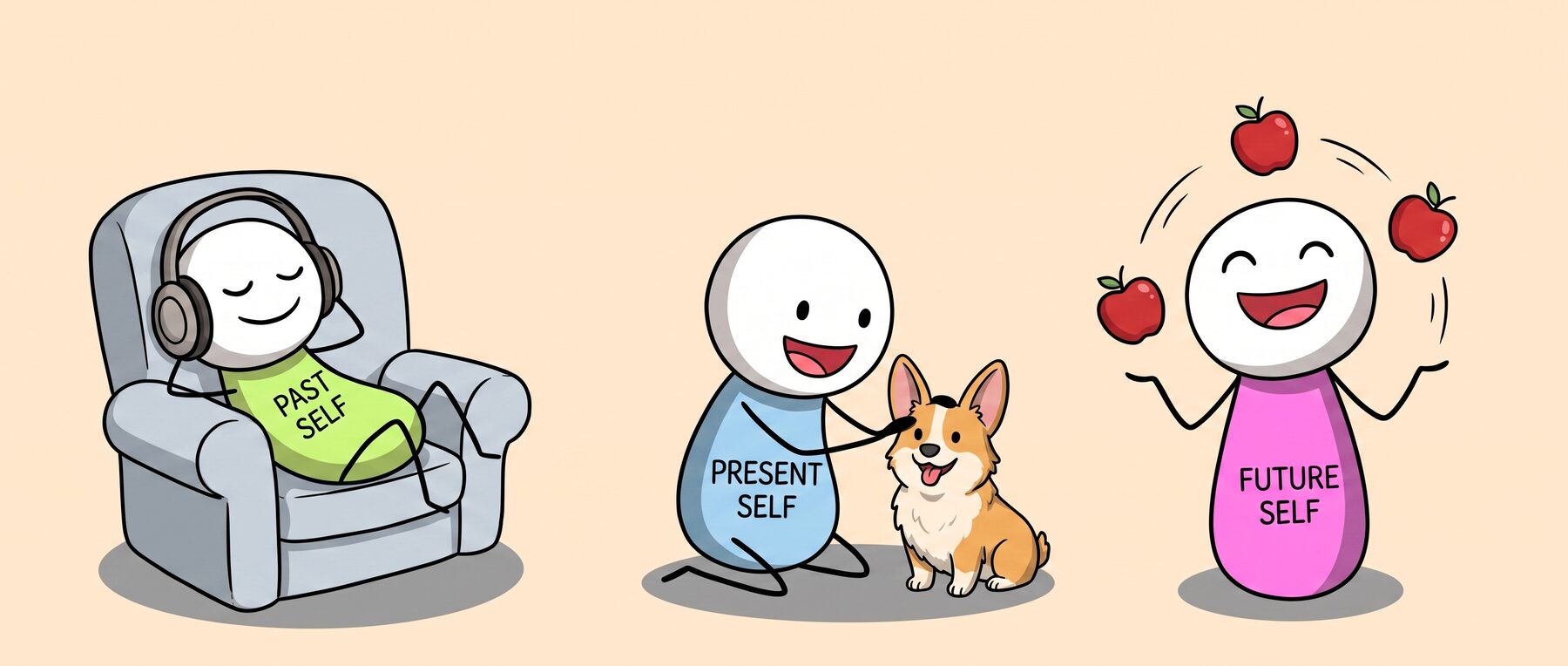
Picture your past self, present self, and future self as three coworkers. Functionally, they are. They interact constantly, and their behaviors evolve based on previous interactions.
Here is the mechanism at the heart of everything, a rerendering of our earlier hand-drawn sketch:
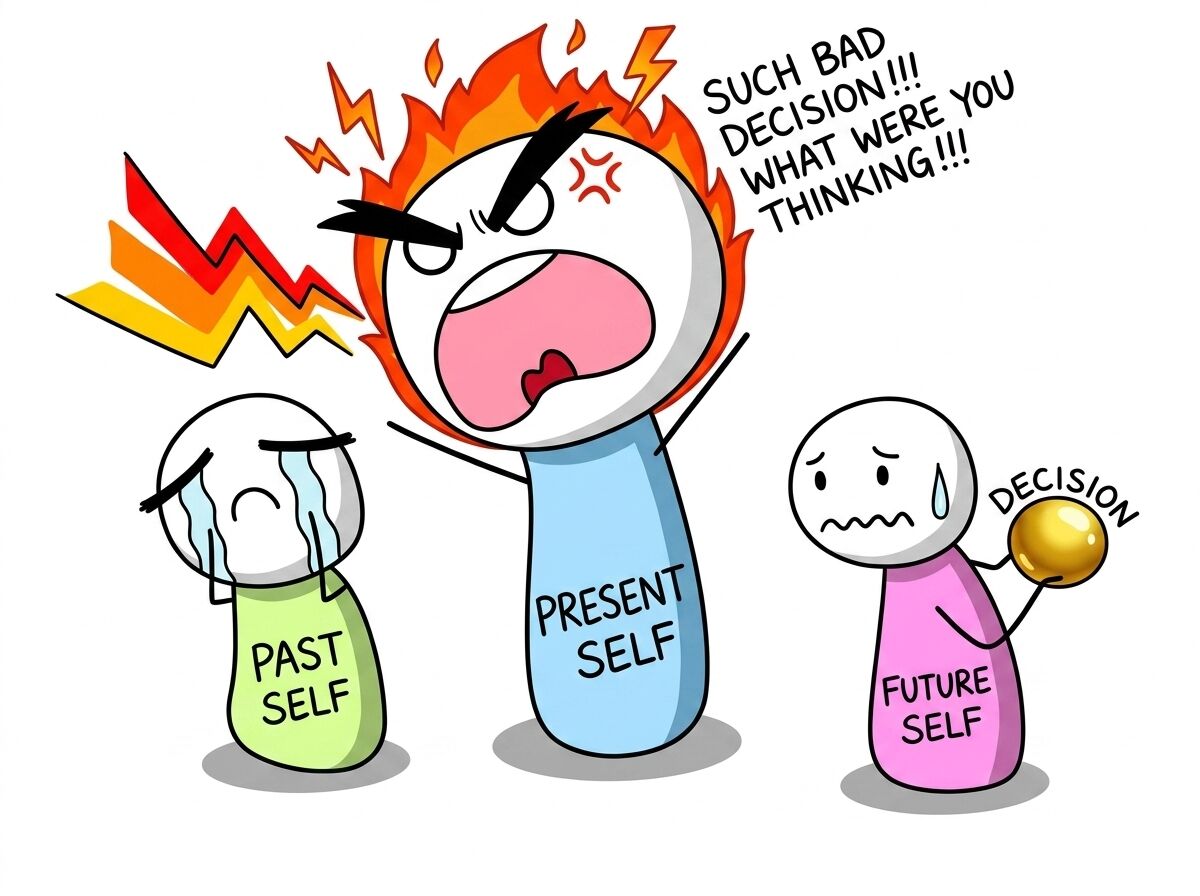
When your present self scolds your past self for messing up with a poor choice, your future self is in the room. The lesson lands quietly: deciding is dangerous around here. That is the fear of regret being manufactured. In-house. By you.
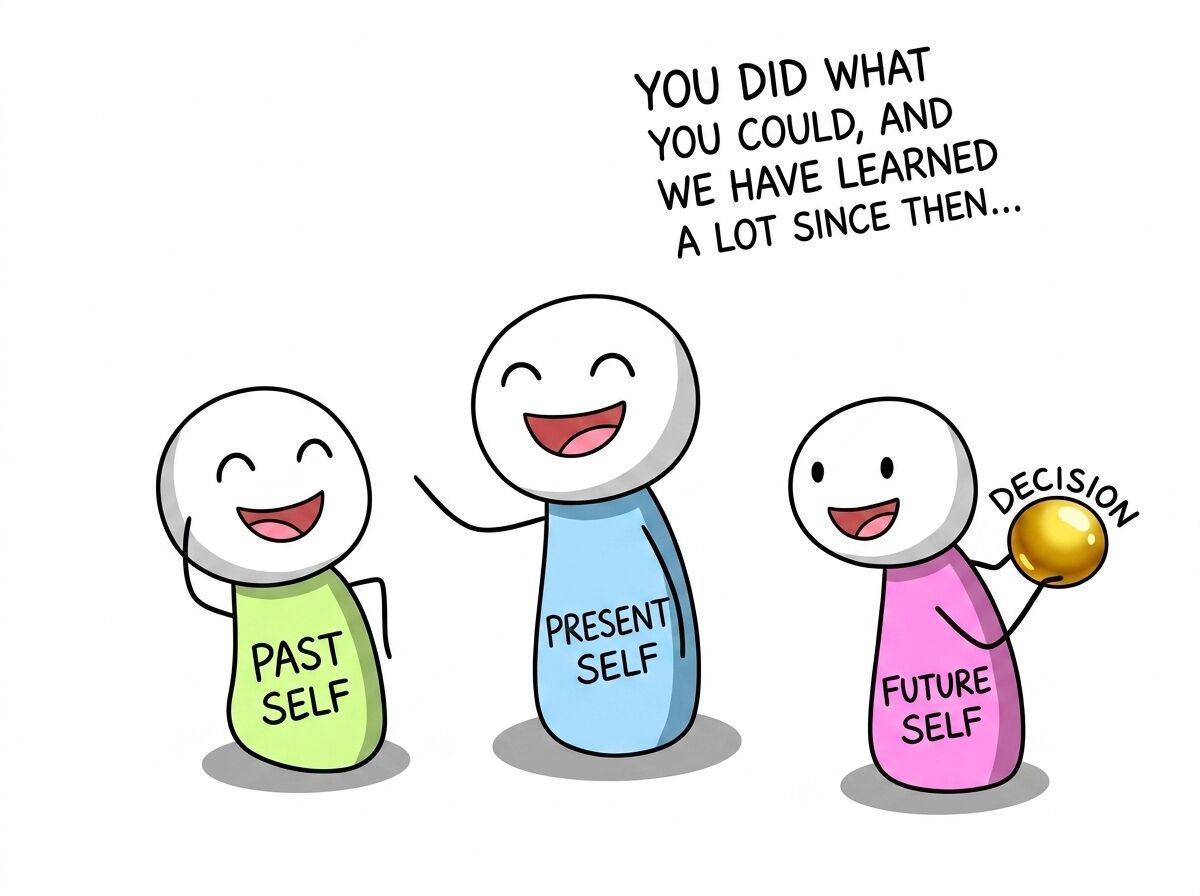
Now flip it. When your present self is fair to your past self - "you did what you could, and we have learned a lot since then" - your future self learns the opposite lesson. Deciding is safe here. Even when the outcome disappoints.
Remember: you always know more later than now. Judging a past decision with present knowledge is blaming someone for not knowing what nobody could've known.
Now look at the kind boss's words again: "we have learned a lot since then." That is what psychologists call a growth mindset: treating judgment as a skill that grows with every decision, not a fixed trait standing trial at every outcome.
So, in sum: be kind to your past self, so your present self is not afraid to act - and your future self will be courageous and ready.
The Job Is Open
Supportive. Patient. Forgiving. Believing in your growth. Every quality on that wish list is a gift you can give yourself by being your own good boss. A good boss never confuses a bad result with a bad decision. Never scolds with hindsight. And knows that deciding is exactly how the growing happens.
This philosophy is baked into HeroMode: progress over perfection, and no mechanism for punishing yourself about yesterday. But you don't need an app to start. The next time you freeze between options, listen for the boss's voice in your head. If it's the mean one, fire it. And welcome your new best boss.